Restore + Connect + Engage
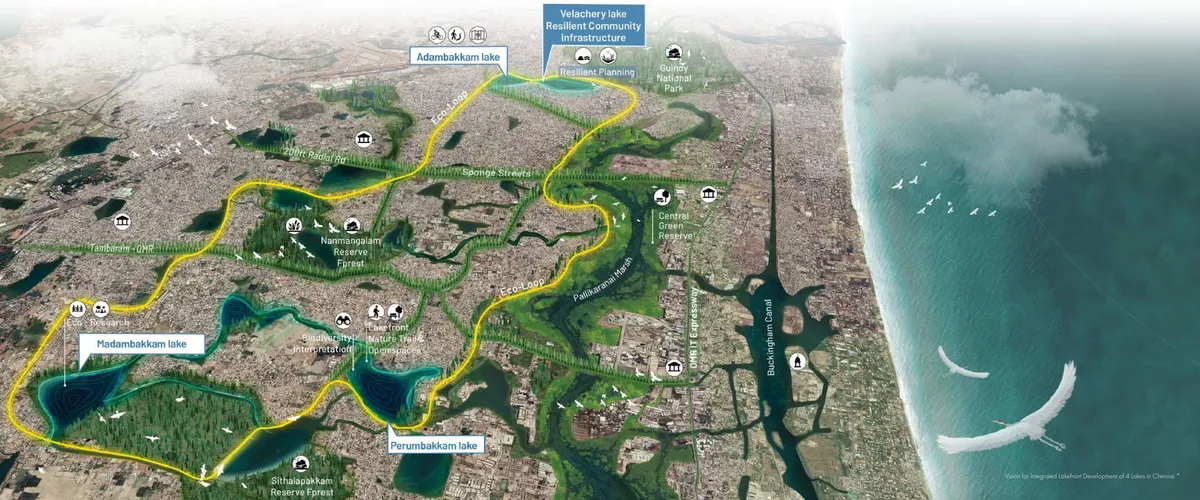
A 3-step framework linking 4 Chennai lakes as resilient community infrastructure.
- 4Lakes in the integrated vision
- 3Framework steps — Restore, Connect, Engage
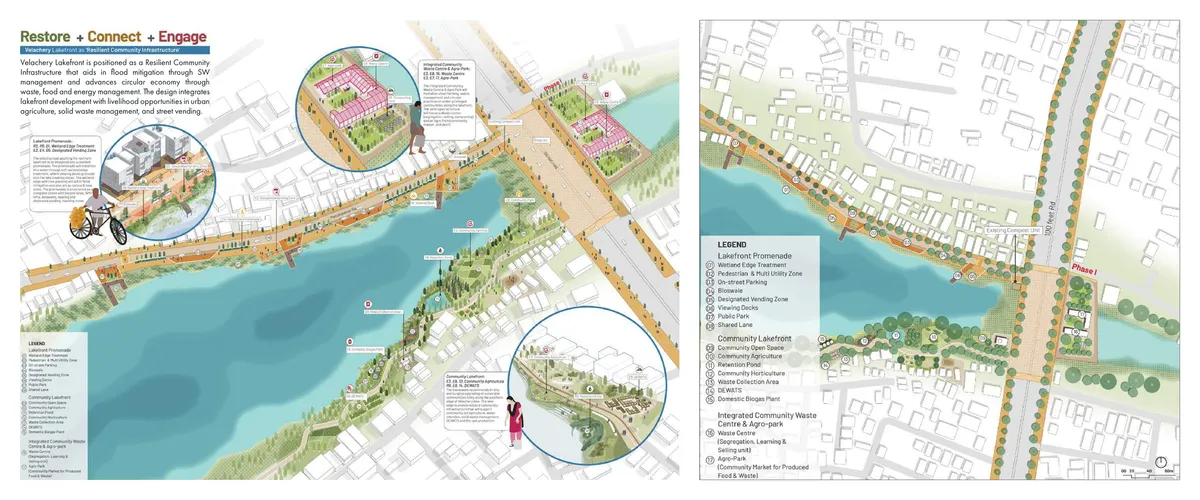
- 17Numbered interventions along the Velachery lakefront
Problem
Chennai’s lakes — Velachery, Adambakkam, Perumbakkam, and Madambakkam among them — are threatened by sewage, waste, encroachment, and unplanned development, even though they sit at the center of the Chennai Metropolitan Area’s southward growth along the GST and OMR corridors. Treating them as leftover water bodies rather than infrastructure was the problem; the competition brief asked for a systems approach that could rejuvenate all four as one connected asset rather than four separate cleanup projects.
Approach
As design assistant, visualization lead, and analytics coordinator, I led 3D massing in SketchUp for perspective collages and detailed axonometric views, and supported the analysis team in validating the technical datasets — urban growth, street network, transit and walkability, topography, natural drainage, and green cover — that the framework is built on.
| Source | Product | Access |
|---|---|---|
| Urban growth & accessibility scan | Growth corridors, street network, transit and walkability around each lake | Team-compiled from municipal and OSM sources |
| Environmental & hydro-ecological scan | Topography, natural drainage, green cover across the Pallikaranai basin/watershed | Team-compiled GIS analysis |
The proposal organizes every intervention under three verbs: restore, by improving water quality, storage capacity, and groundwater infiltration and providing habitat for native species; connect, by making the lakefront publicly accessible and linked to sustainable mobility; and engage, by ensuring the lakes’ sustainability through community buy-in, local stewardship, and culturally meaningful interaction with water.
Results
Velachery Lakefront is the framework’s pilot — positioned as resilient community infrastructure that mitigates flooding through stormwater management while advancing a circular economy through waste, food, and energy management, integrating urban agriculture, solid-waste management, and street vending into the same lakefront promenade.
Winner, Chennai Lakefront Rejuvenation Competition, Chennai Metropolitan Development Authority, 2023.
What I’d do differently
The framework is explicit about Phase I at Velachery but doesn’t state how the other three lakes sequence relative to it or to each other. A cross-lake prioritization — by flood risk reduction per rupee, the same logic the Adyar Basin evaluation matrix used — would turn four independent lake plans into one investable programme.
Share this page
https://abdulkalam.pages.dev/projects/chennai-lakefront-restore-connect-engage/
Scan to open this page. Download the SVG for print.
